
Next Course Starting June 16th. Sign Up!

Respectful Parent

Parent Effectiveness Training, San Diego Parenting Classes

  • Home
  • About Kelly
    • Parenting Philosophy
    • What You Will Learn
    • Testimonials
  • Services
    • Classes & Workshops
    • Personal Coaching
    • Speaking Engagements
  • Resources
    • Parenting Books
    • Children’s Books
    • Thoughtful Independent Play Toys & Gift Guide
    • Awesome Parenting Gear
  • Free Consult
  • Contact
  • Blog
  • Privacy Policy

One Surefire Way Your Kids Can Problem Solve (and Get Along!)

February 8, 2016

Children and conflict—it’s inevitable. As adults, we often assume it is our job to problem-solve these conflicts for them. However, what if that isn’t our job? What if the kids are capable?  By solving their own problems they can become confident problem solvers that need less and less adult “help” to solve minor and, sometimes, not-so-minor problems.  This approach works great with siblings, but I recently had the chance to try problem-solving out with a larger group of children and the result was just as cool.

There were five kids at my house when the yelling started; I went around the corner to see what was going on. The three boys were yelling at the two girls and the girls were giving it right back. It had been raining for two days and the kids were out of patience. The boys were threatening the girls; the girls were crying. This wasn’t going to solve itself. I jumped in with, “It sounds like you all might need some help.” Cries of injustice came at me all at once. They all wanted to use the TV and no one could agree on what to do. The boys wanted to play Just Dance, a video game that is played by dancing, and the girls wanted to watch a movie my daughter’s friend brought over. The boys said they would only watch TV if it was Star Wars. The girls did not agree. At all. Insults were flying—it was total mayhem.

Since I teach P.E.T. (Parent Effectiveness Training), my two kids are familiar with problem-solving, technically speaking—Method III Problem Solving.  I asked my two, “What do you think about problem-solving this one?” They both energetically agreed.

Explain the Method

I went on to explain that we first try to figure out what each person really needs and from there we think of as many solutions as we can. I explained that when we run out of ideas, we are done brainstorming, and can then start to eliminate the ideas that don’t work for the whole group. When we started the first part of the process, identifying the needs of the boys and the girls, I explained that needs are why the person wants what they want or what it will do for them. For example, “needing to watch TV” is not a need, but being able to relax and calm down is a need. TV is one way to do that. Brainstorming ideas are “anything goes ideas” that cannot be judged or dismissed. Everything gets written down.  Once everyone was clear on how to participate, we started solving.

Problem Solving in Action
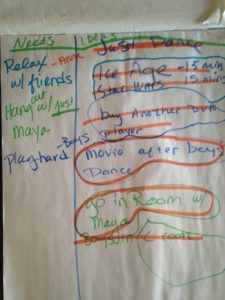
Problem Solving2
Problem Solving

When my 4-year-old daughter told me that her need was to watch TV with her friend, I was able Active Listen a bit, “You really want to watch with your friend” “Yes, I want to snuggle in the brown chair.” she replied. “Yes, I want to be with JUST her.”  Aha! There was the need – she wanted time together with just her friend – companionship.

I went on to help the boys ages ranging from 3–7,  figure out what they needed. They said, “To play Just Dance.” I confirmed “You really want to dance” And they told me right away that they needed to move because they had too much energy and they wanted to play hard.  “OK,” I said, “There are your needs, now we can solve them, let’s think of ideas.”

Once we defined the needs and the real cause of the problem, we were easily able to solve it. The girls’ need was to spend time together alone to bond. The boys’ real need was to release energy. Knowing this information was key to the solutions they thought of and allowed them to solve the issue in about three minutes.

Decide on the Solution

Brainstorming ideas were all over the board, from taking turns watching their movies every 15 minutes to buying another DVD player. We wrote them all down. No judgment, remember?

Once we were done coming up with ideas, they crossed off the ones that anyone didn’t like.  Fortunately, I get a say here, too, and was able to cross off running to the store for a new DVD player! The kids were able to agree that the girls would play together upstairs so they could still be alone together and the boys would play Just Dance to get their energy out while it was raining. The girls would watch their movie after the boys were done with their game.  It was a win-win, or, rather, a “no-lose” solution. Everyone had a solution they were happy with and nobody felt they had lost in the negotiations. And I got to finish eating in peace!

When the arguing first started, I was tempted to offer my own solution (roadblock) and let them watch the movie the friend had brought over because it was a “special treat.”  THIS WAS NOT THE NEED! The need was companionship and closeness. I would have prolonged the arguing because I was solving the wrong problem.  This is why child-led problem solving is so great!  The underlying needs were addressed, the agreed-upon plan was honored without any intervention from me, and there was no more arguing the rest of the day.

AdinaVoicu / Pixabay

It is empowering for children to solve their own problems. Perhaps our job isn’t to solve problems for our children. Our job is to let them solve their own. When we assume they are capable, instead of incapable, we can offer the minimal amount of guidance necessary for them to be successful on their own. This perspective allows them the time and space to solve problems on their own and it builds confidence. When we let them reflect on their needs, it creates self-awareness—they can think more deeply and critically.  As they learn how to do this effectively, they become empowered, competent, and empathetic problem solvers.  The three minutes that it took to facilitate this prevented an afternoon of conflict, tattling, and tears because their solutions addressed the real problems. When children are put in charge of their own problems, they rely less on the adults and more on themselves. Win-win!


To learn more about P.E.T, check out the P.E.T. book or see if a class is in your city.

You might also like:

The Gift of Silence and How it Solved our Shoe Problems

The Day I Got Helicopter Parented

 

Categories: Behavior & Discipline, Emotional Health & Safety 3 Comments / Share

« Why I Don’t Spank, Punish or Bribe My Kids
Why Connection Isn’t a Reward for Rude Behavior »

Comments

  1. Tuba ustun says

    March 22, 2023 at 3:46 am

    Thank you Kelly , every parent need this informations 🙏

    Reply

Trackbacks

  1. Mean Things Kids Say - and What they REALLY Mean - Respectful Parent says:
    January 5, 2018 at 12:20 pm

    […] One Surefire Way Your Kids Can Problem Solve and Get Along – Respectful Parent […]

    Reply
  2. Awesome Environment Hacks that Stop Nagging | Respectful Parent says:
    August 4, 2018 at 1:50 pm

    […] Other links you may like: One Sure Fire Way Your Kids Can Problem Solve and Get Along  […]

    Reply

Leave a Reply Cancel reply

Your email address will not be published. Required fields are marked *

Your journey for better parenting starts here! Sign up for our newsletter and get expert advice on effective parenting techniques delivered to your inbox.

Topics

  • babies
  • Behavior & Discipline
  • Big Kids (6-12)
  • Development
  • education
  • Emotional Health & Safety
  • Family & Siblings
  • Feeding & Nutrition
  • Hygiene & Potty
  • Physical Health & Safety
  • Play & Education
  • Pregnancy & Fertility
  • preschoolers (age 3- 5)
  • Sleep
  • Teens
  • Toddlers


Classes & Workshops

Classes & Workshops — Bringing parents together to have more confidence in parenting...even when it's hard. Book your seat now →

Personal Coaching

Set up a one-on-one session for your unique situation & start implementing strategies confidently and quickly. Request a free consultation →

Speaking Engagements

Ask Kelly to talk at your school, workplace, place of worship or other community event. Learn More →


Your journey for better parenting starts here! We will guide you & mentor you for maintaining better relationships with your kids. Sign up for our newsletter and get tips & expert advice on effective parenting techniques delivered to your inbox.

Daily Parenting Inspiration

“My child is not giving me a hard time… my child i “My child is not giving me a hard time…
my child is having a hard time.”

That one shift changes everything.

Less: “Why are they doing this?”
More: “What’s going on for them?”

Hard behavior is often just… hard feelings.

When we see the struggle,
we respond differently.

Less reacting.
More supporting. 💛 #respectfulparent #sandiegomoms #parenteffectivenesstraining #attachmentparenting #rie #PositiveParenting #parentingtips #DefianceOrMisunderstanding
“I didn’t say it was your fault… I said I blame yo “I didn’t say it was your fault…
I said I blame you.” 😅

When kids blame, it feels personal.

But it’s usually not about being right…
it’s about letting out big feelings.

Blame =
“I’m frustrated.”
“I’m overwhelmed.”

Before correcting, try connecting:

“You’re really upset.”
“That was hard.”

Less defending.
More understanding. 💛
“Children do well when they can.” So when they’re “Children do well when they can.”

So when they’re not…
It’s not about won’t.
It’s about can’t (yet).

Less: “Why are they acting like this?”
More: “What’s getting in their way?”

Skills take time.
Emotions get big.
Brains get overwhelmed.

And in those moments,
they don’t need perfection…

They need curiosity - not furiosity. 😋💛

Yup, I made up a word.

#respectfulparent #childrendowellwhentheycan #drrossgreen #parenteffectivenesstraining
End of school = chaos… Then suddenly… no structure End of school = chaos…
Then suddenly… no structure 😅

Or camp… to camp… to camp.

Summer is fun ☀️
But it can also mean:
more pushback
more “I’m bored”
more sibling stuff
more BIG feelings

And when routines change, behavior usually does too.

The good news?
You don’t need more control… you need better tools.

✨ listen without shutting them down
✨ set limits without the battles
✨ handle big emotions (theirs + yours)

Less surviving
More thriving

My summer Parent Effectiveness Training class is coming up 💛
Drop a ☀️ and I’ll send details!

 #respectfulparent #sandiegomoms #parentingtips #parentingmiddleschoolers #PositiveParenting #attachmentparenting #rie #parenteffectivenesstraining #RespectfulParenting
Oof. This is a hard one sometimes! Share your exam Oof. This is a hard one sometimes! Share your examples of a time this happened 🙏🏼🙈
I'm just reading the book "Untangled -Guiding Teen I'm just reading the book "Untangled -Guiding Teenage Girls Through The Seven Transitions into Adulthood" by @lisa.damour ,  and I love it. This one struck a chord with me so I thought I'd share. It's from the section "The Pull of Popular."

What does “popular” actually mean?

Because when you look a little closer, the kids who seem the most “popular” aren’t always the most liked. Sometimes, their influence comes from social power, not genuine connection. And that can come with a lot of pressure—on everyone.

This can be a powerful conversation to have with your child.

Not in a lecture-y way, but with curiosity:
“Do kids actually like being around her, or are they worried about being on her bad side?”
“What makes a friendship feel good to you?”

Helping kids think beyond popularity and toward the quality of their friendships gives them something much steadier to stand on.

Because in the long run, feeling safe, accepted, and able to be yourself matters a whole lot more than being “popular" and then you may just hit that sweet spot of being "popular" because you are well liked!

 #parentingtips #sandiegomoms #respectfulparent #raisingteenagegirls #parentingmiddleschoolgirls
We have dreams for our kids. The friends we hope We have dreams for our kids.

The friends we hope they choose.
The sports we hope they love.
The grades we hope they earn.
The path we quietly map out in our minds…

And then they grow.
And they choose.

Sometimes differently than we imagined.

And that’s where it gets uncomfortable.

Because the real question becomes:
Are we raising children who follow our path…
or children who can find their own?

Letting go doesn’t mean stepping back completely.
It means shifting roles.

From director ➡️ to guide
From fixing ➡️ to listening
From telling ➡️ to being available

It means offering wisdom when it’s invited,
and trusting them enough to figure some things out on their own.

That’s not easy.

But that’s where confidence is built.
That’s where ownership grows.
That’s where they become themselves.

Not a version of us.

If this hits home, this is exactly the kind of skill we work on in Parent Effectiveness Training—how to support your kids without shutting them down.
My next class starts in less than two weeks:
☀️ Tuesday Mornings
🗓️ April 7th – May 26th
⏰ 9:30 am – 12:30 pm (Pacific Time)
📚 Eight classes
And of course, I'm still working on this!

Reg info in first comments/bio 👇👇
My daughter was venting to me about a recent pract My daughter was venting to me about a recent practice…
and of course, I did what many of us do.

I offered a solution, "I mean, you don't really need to go next time; it's optional." 

Her response?

“Mom… I just need to complain, not fix it. I'm still going.”

…Heard. 😅

It was such a good reminder.

When kids come to us upset, our instinct is to help. To fix. To make it better. But sometimes all of our great ideas land like this:

🚪 door closes
😶 conversation over

Because what they actually needed wasn’t a solution.
It was space.

Space to vent.
Space to feel heard.
Space to figure it out themselves.

And when we jump in too quickly with advice, it can unintentionally send the message:
“You can’t handle this.”
or
“Your feelings need fixing.”

Even when that’s the last thing we mean.

Sometimes the most helpful thing we can say is:
“That sounds really frustrating.”
“Ugh, that’s tough.”
“I’m here.”

That’s it.

No fixing. No coaching. No life lesson.

Just connection. 💛

(Still practicing this over here, by the way 🙋‍♀️)

If this hits home, this is exactly the kind of skill we work on in Parent Effectiveness Training—how to support your kids without shutting them down.

My next class starts in less than two weeks:

☀️ Tuesday Mornings
🗓️ April 7th – May 26th
⏰ 9:30 am – 12:30 pm (Pacific Time)
📚 Eight classes
And of course, I did what many of us do.
Reg info in first comment 👇👇

Come learn how to listen in a way that actually keeps your kids talking.

 #PositiveParenting #parentingclasses #ParentEffectivenessTraining #respectfulparent #rie #attachmentparenting #sandiegomoms #parentingtips
Follow on Instagram


  • Privacy Policy
  • Free Consult

© 2026 Respectful Parent · All Rights Reserved.

  • Facebook
  • Instagram