– by Dawn Pedersen
Helicopter Parenting. Most of us have heard the term. We use it to describe the actions of parents who hover next to their children at all times, making sure they are never bored and never get hurt.
Many of us agree that helicopter parenting makes it difficult for these children to negotiate the world later in life. They have not learned to cope without a parent. These are eventually the adults who bring mom with them to a job interview.
I’d argue that helicopter parenting goes much broader. I’d propose that it encompasses many of the mainstream parenting techniques that are championed by today’s parenting “experts” and blogs. I’m looking at you, Parents Magazine.
In fact, much of what is typically done in the name of parenting stifles our children’s autonomy. It sets them up for painful struggles in the future. We so get up in their business that they are shocked when they try and fail. And they think failure is to be avoided at all costs (it’s not). So they refuse to try.
Here are some of the hallmarks of mainstream parenting advice. And what the research suggests you should do instead if you want capable, self-confident kids.
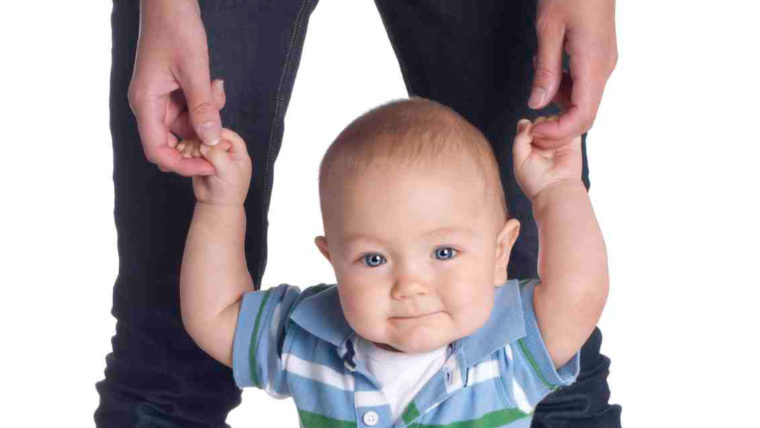
1. “Walking” a Baby
Why parents do it.
Why do parents “help” a baby learned to walk by holding them upright by their two hands, and letting them step forward? The simple answer is: we see other parents do it, so we assume that we are supposed to teach our babies to walk in this way. Or sometimes we do it because friends and relatives keep asking whether baby is walking yet, so we feel insecure and try to hurry the process up. What’s worse, many websites encourage us to speed up a child’s motor development.
I watched a mom do this just yesterday. Real nice woman I’d met years ago. It pained me to see her “walk” her baby around the playground, she hunching over as as he kept struggling to be free from her hands, and explore on his own. I wish I could have told her the following without hurting her feelings.
What works better for kids.
You know what other species of mammal teaches babies how to walk? None of them. Some like horses can walk within minutes of birth, and some take longer. Humans take quite a long time because our brains aren’t prepared yet at birth.
Why don’t humans stay in the womb long enough to develop the ability to walk? Well then, our big brains in their big skulls wouldn’t fit through mom’s pelvis any more. So instead we come out early and rather helpless.
But we get there. All humans (barring disability) will figure out how to walk on their own. Most babies reach this milestone on their very own somewhere between 9 and 15 months old, but it’s not unusual for it to take up to 18 months. Each baby should be allowed to follow the typical sequence of sitting up, pulling to a stand, and cruising, without any assistance from others or from push toys/walkers. Let her gross motor development occur naturally.
You’re probably not going to speed up a child’s development by “teaching” her to walk anyway, and the message you are sending to her is “you are not capable without me”. In fact, you are creating a false sense of security and safety when you do not let your child negotiate environments on her own and practice assessing risk.
2. Training to go Potty
Why parents do it.
Lots of reasons. Disposable diapers are expensive and cloth diapers take work to clean. Everybody else potty trains. Some preschools require it prior to admission. We’re told that generations ago, babies were potty trained by the age of 2.
This is another milestone we are pressured by others to accelerate, and we are encouraged to use all manner of elaborate schemes to do so.
What works better for kids.
Are you nuts? Let a child potty train himself?
Yup. And he will. Without praise, lies, bribes, lectures, forced naked time, constant vigilance, or every-20-minutes interruptions of playtime.
Sadly, urologists frequently get little ones who are suffering from chronic holding due to inelegantly-handled potty training.
In toilet-trained children, chronic holding is the root cause of virtually all toileting problems, including daytime pee and poop accidents, bedwetting, urinary frequency and urinary tract infections.
– Steve Hodges, M.D., A Doctor Responds: Don’t Potty Train Your Baby
When you wait for your child to learn how to go potty in a completely self-initiated way, you allow him to develop all the necessary physical and mental requirements for healthy bathroom habits.
If you try to make it happen on your time table, not only are you risking the chronic holding described in the article linked above, but you may actually delay the process with a strong-willed child. In a world where your little one may have very little under his control, he may dig his feet into the dirt, so to speak, when confronted with attempts by you or others to regulate his bodily processes too.
I was guilty of pressuring my son for a while. But my trusted friends said, back off mama and let him tell you when he’s ready. Let go of the feeling that he won’t ever get it if you don’t keep reminding him. He’ll get it.
3. Forcing Sharing
Why parents do it.
We don’t trust our kids. We don’t trust them to learn it all on their own, to develop empathy and collaboration skills without being told how.
Lots of parenting resources tell us we should be forcing our children to share. Okay, you may be calling it “teaching to share”, but it amounts to the same thing. I can’t go to any public place without seeing parents who are fretting about sharing, coaching their little kids to do it, and sometimes even punishing them when they refuse.
This is another arena of child-raising that is rife with ridiculous tips.
What works better for kids.
Imagine you are sitting in a coffee shop working with focus and intention on your laptop. Now imagine a much bigger person handing your device to your next-door neighbor and saying, “Now you need to SHARE! Sharing is caring!” You were right in the middle of a message to someone, and you have no idea when your computer will be returned, but you haven’t been given any choice in the matter.
We wouldn’t do this to another adult. Why is it okay to do to a child with a toy? What it teaches them it that they can be violated without cause, that their uninterrupted play is frivolous to adults, and that they cannot be trusted to manage conflict on their own.
One really nasty result of this fairly recent culture-wide push to force sharing on children, is that they turn this around. So many times I have seen a child walk up to another child who was playing with something, and immediately demand the toy be handed over by proclaiming “you need to share”. Surely this is not the behavior we wish to encourage?
Self-driven sharing that develops with maturity and which is taught largely through modelling by parents and caregivers, is a glorious thing. It happens in due time, and without the exasperation and embarrassment that affects all parties young and old when sharing is forced.
Conclusion
Make no mistake. These preferable approaches are not lazy nor over-permissive. They don’t encourage you to disengage you from your children. In fact, they help build better bonds because you’re not trying so hard to manipulate a fellow human being. Parenting is still hard work, but let’s cut out all the convoluted “tips and tricks”. Take a chill pill and enjoy your kids.

Well, not that what you say is Wrong…. But each child is different, so as a parent it’s my Role to pick up on their ques. Some children need more attention & affection, where others do not. Each child is different.
With that said, if my child insists on more attention, but I don’t provide it because I’m afraid to “helicopter” there would be a breach of trust. Same if my child didn’t require my attention, but I latch on…. There too, would be a breach.
Where one parenting method works with one child, it will not necessarily work w the next child.
I’ve seen 5 month old go on the potty with parents assistance. Why? Because children give ques. If you watch for ques, you act… And there’s less diaper clean up.
Pay attention to your child’s needs, and you won’t fail. That is all.
Sharing is important…. But you teach your child by sharing with them. Not taking things away. My 11 yr old son shares when he is willing to, because he knows based on this metod, that it makes both parties happy. I agre w you on this point- to a point-
I agree with you that “potty training” is not necessary, however that doesn’t necessarily entail just waiting until the kid is old enough to choose to “potty train” themselves, there are plenty of respectful & non-pressured ways to help them become familiar with the process at a young age which can result in them using the potty independently much younger than is typical these days. We introduced a potty as part of our nappy changing routine as soon as our youngest could sit up (about 6 months) and with virtually no intervention on our part she’s almost “potty trained” at 2! We’ve literally done nothing other than put her on the potty when we change her (we didn’t actively encourage her to produce anything, other than showing genuine but not excessive pleasure when she did) and watch out for signals that she might need to use the potty (not formal Elimination Communication, but following a similar logic of just being responsive & communicative with your child about their elimination). As she’s got older we’ve talked to her occasionally about using the potty & toilet, but there has been nothing in the way of active training really. I can’t quite believe how easy it’s been compared to the “traditional” potty training methods I used with my older kids! So much less stressful for all concerned, and fewer dirty nappies is an added bonus 🙂