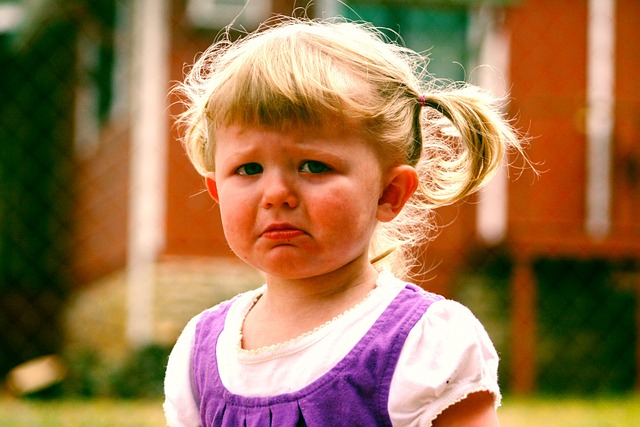
Today I am sharing a guest post from my friend Jeannie who blogs over at The Magic Nutshell. Jeannie is a creative writer, mother, and self-named “professional social justice sidekick”. Thanks for sharing, Jeannie!
My two-year-old daughter is the only juvenile human on my mother’s side of my family. My grandparents had five children, but only one of them (my mom) became a parent, and only one of her children (me) has had a child—possibly the only great-grandchild my grandparents will ever see. How times have changed! Children are not quite the expected and ever-present fact of life that they were in previous generations. Children are more precious than ever, yet it seems that child-free adults are less tolerant of childishness than ever before. My older relatives seem eager to see my daughter at family gatherings, but when she does anything characteristic of a two-year-old (like hide her face shyly when personal questions are barked at her), they often say things like, “Oh look, you’ve turned into a spoiled brat!” I’m tempted to respond with, “Oh look, you’ve turned into a rancid old biddy!” but our culture frowns upon disrespecting our elders the same way that we do to children. Why is that?
Ben Martin, marriage editor at The Good Men Project, wrote an article called “Why Aren’t We Rude to Grown-Ups the Way We Are Rude to Kids?” It seems obvious to me why it’s not socially acceptable for adults to treat each other like trash all the time, but it begs the question, “Why do so many adults think it is acceptable to be rude to kids?”
I think there are both external and internal reasons why many adults in our society respond to children this way. Martin gives some examples of adults who seem to be at their wits’ end in situations where they are in charge of large groups of children. Western culture is unusual in our expectation that lone adults (parents, nannies, teachers, etc.) should be able to manage whole herds of kids for extended periods of time. Of course, positive qualities like patience and affection wear thin when spread out among 20 or 30 energetic youngsters. But I think there’s more to our culture’s acceptance of disdain for minors.
First, there are cultural beliefs about how children should be raised which are changing so rapidly than not everyone has kept up with the program. In my own family, I see a vast difference in generational beliefs about children and the dreaded “spoiling.” My grandparents both come from ultra-conservative, German Catholic immigrant families. Their parents valued severity and wholesome “strictness,” which certainly did not exclude the use of corporal punishment. Legend has it that my grandfather’s father was brutally abusive, although nobody likes to talk about those things—“no talking” is a favorite phrase of my grandmother when conversations deviate from topics you might hear on The Andy Griffith Show. And of course, it applies especially to children, who “should be seen and not heard.”
In generations past, I understand that it was more important to establish a strong pecking order within the family and society to keep large herds of children in line. My grandparents come from a culture that abhors birth control and glorifies large families with cowed, mute, and obedient children. On the occasions when my grandparents used to take their five children out to a restaurant, they were often praised with comments such as, “Your children are so good! They haven’t made a peep this whole time.” It was a point of pride for parents to train children to be as quiet and as responsive to commands as working dogs.
Up until the past century, children were also expected to earn their keep by working very hard, either in the home or out on a farm or in a factory making slave wages. Play, frivolity, creativity, and individuality were not valued, because the survival of the family had to come first. In these scenarios, which seem cruel and bleak to me and my circle of parental peers, most families were just not high enough on Maslow’s hierarchy of needs to put that much thought or resources into the emotional development or long-term wellness of an individual child.
Ancient and medieval history corroborates the idea that socially pervasive ill-treatment of children had certain perceived advantages (however unattractive to modern people) that were valued at certain times and places. It is said that the ancient Magyars, a fierce tribe of Eurasian raiders, would slice their newborn babies’ faces with a knife so that they would know pain before their mother’s milk. This was believed to toughen them up in a culture that valued aggression and violence. There are many other less drastic examples to be found of cultures, or subcultures, that actively try to instill violence in their children for various reasons—to help them become “top dog” in a vicious society or to attempt to protect them from harm with a “bully first or be bullied” mentality.
Then there are fundamentalist religious circles that believe physical abuse is good for children because they think treating children roughly will somehow teach them gentleness. The Biblical phrase “spare the rod and spoil the child” is especially beloved, taken to extremes, and misunderstood by religious zealots with poor educations.
Old habits die hard. By default, people tend to treat children the way they themselves were treated as children. It’s very ironic that the people who believe children learn from punishment, not example, are the ones who mistreat children simply because that’s how they were raised—obviously, they learned from example. I see memes and hear people boasting that they learned respect by being spanked. Apparently, they also learned to trust the thinking of their elders by being lied to or denied information on “adult” subjects. In reality, these people who take pride in their own mistreatment as children feel justified in passing along the cycle of dysfunction—supposedly for the good of the children.
Many people actively promote abusive treatment of children due to beliefs that they somehow benefit the children, but I think there is still more to why everyday Americans feel so comfortable acting rude to kids. I think that much of the time, it happens for the opposite reason—many adults simply don’t care about children. They don’t respect or value their existence. There are socially conservative holdovers from my parents’ and grandparents’ generations that believe all childlike behaviors and qualities should be driven out of children like demon spirits, and then there are socially liberal people who have contempt for young families due to fears of overpopulation and the soul-staining power of the carbon footprint.
Both camps fail to understand that today’s children are the future, like it or not, and the way we treat them is our shared legacy as human beings. Furthermore, the way we treat them is the way they learn how to treat others and themselves.
Conservative and liberal ethics seem like polar opposites much of the time, but there are common threads in obsessions with purity (whether it’s sexual or nutritional, religious or political). The worst insult we throw at children, and the worst fear that parents have about their children is that they are “spoiled.”
We all agree that spoilage is the worst, though we have terribly vague and conflicting notions about what it means or how it happens. Obviously, our children are not slabs of dead meat that will start to rot at the first sign of warmth. Yet there’s this baffling conflation, in our culture, of materialism with emotional nurturing. The term “spoiled” is hurled at children whose parents try to fill the holes of neglect with material possessions, but it’s also used on children whose parents shower them with affection.
Regardless of what it means exactly, the most toxic thing about the “spoiled rotten” insult is that it places the shame directly on the child, taking the focus off the child’s caregivers and social network. We do shame parents by accusing them of “spoiling” their kids, but it’s the child who bears the image of irreparable tarnish and degradation, not the people who supposedly caused the damage. And it further justifies harshly judgmental, punitive treatment of the child by everyone, even strangers passing by.
Across generations and belief systems, I think it has become cool, in our society, to despise children. George Carlin got a lot of laughs when he said, “Children are overrated.” Since the advent of effective birth control half a century ago, having children has become a matter of personal choice for most people today. Some folks even view reproduction as an expensive, wasteful vanity project. In highly developed societies from Germany to California and elsewhere, most young adults put off having children until later in life and have far fewer of them (if any) than those who came of age before the sixties. Western culture values money, investments, productivity, and adult-oriented recreation. Of course, none of those things would continue to be possible without any new adults coming into the workforce, but children are awfully labor-intensive and unpredictable creations. In our fast-paced world, the blissfully child-free tend to view parenting as a questionable life choice, a foolish investment, or a public nuisance, not something to be encouraged, celebrated, or supported.
What gives me hope is that the attitudes of strangers and distant relatives matter far less to children than the love of their parents. And today’s parents are more conscientious than ever before—with good reason. Today’s children will need a complex set of social and intellectual skills to adapt in a world that is rapidly changing—mostly for the better. Life expectancy in the developed world has reached a historic high of about 80 years—most people now live for the better part of a century (sometimes even more), and they need solid foundations of physical, mental, and emotional health as well as intellectual, creative, and leadership skills. We need people who will support one another in positive, long-term relationships and thrive for many decades of life as contributing members of the most peaceful generation in all of history.
Our goals as gentle parents are far different from many of our ancestors’. Instead of raising fearsome aggressors trained to beat off attackers with a club until they reach the reproductive age of 12, thus carrying on a precarious genetic line, we seek to raise happy, loving, long-lived people. We try to model pro-social behaviors that will help them build supportive social networks and navigate a growing, diversifying world with confidence and grace. We hope to raise innovators who will improve the world they inherit and lead future generations into an increasingly peaceful future. Instead of obedience and submission, we strive to instill trust, creativity, and confidence.
Parents know more about parenting than ever before. I do many things very differently than my parents did, and my parents did things very differently than their own. We live in an information age in which we have access to scientific evidence about how our actions affect our children. Most of us understand that children learn to treat others the way they are treated—respect (not abuse) breeds respect, violence breeds violence, dishonesty breeds dishonesty, and rudeness breeds rudeness. People who are rude to children were children once themselves, and there’s a good chance they did not receive the respect and care that might have raised them into kind adults. It may or may not be too late for them, but it’s not too late for my child to see good behavior modeled in the way I interact with her and with other people—even in tense circumstances.
And that is why when somebody calls my child spoiled rotten, I do not reply with another insult. I simply turn to my child and make sure she feels safe and that she knows she hasn’t become a vile mass of decay. Because if anybody is reaching their expiration date, it’s not her.
** by Jeannie Miernik

I have to say that I agree with what you’re saying here. I’ve noticed there has been a great intolerance for children acting like children, acting their age. Most of the people around me expect children to behave like grown ups and well trained dogs. It’s becoming ridiculous!
This has been driving me crazy, too. I have a two-year old, and people tend to love her so much because she’s naturally quiet and uses her manners in public. But the moment she gets tired and whines, or starts to cry (even though a countdown from three and a big breath calms her down), everyone loses patience. Strangers, older family members, etc. Meanwhile they’ll excuse their snappiness or lack of patience by saying they’re tired, they had a long day, what ever, as if it’s more excusable for an adult to lose their hold over their emotional reactions than for a child with limited communication skills to do the same.
Not only that, but a child distracted by a new discovery or a favorite toy will be accused of being obstinate if he or she doesn’t come when they’re called, but the same adults that seem to hate that the most are the ones that will ignore a child’s attention and questions blatantly and obviously in favor of their phones, the television, or virtually anything without believing that’s rude, as well. They talk loudly over children’s TV shows, over children’s questions, eat off children’s plates without asking… What strange double-standards! Children learn by example, so what makes it okay to adults to BE such poor examples and yet still expect children to know better anyway? I’m so proud of my little one for picking up on so many good, CONSIDERATE behaviors in spite of the examples surrounding her daily. I have to strive every day to continue to cultivate that social strength in her. Our little ones deserve all the support they can get!
As a mother of a one year old, I love and appreciate both the article and this comment.
Being a baby / toddler / kid is hard. Even when adults are being kind (and, as you note, they often aren’t), the grown-ups are all always bigger and more powerful than you. They have all the resources and decision-making power. Whatever adults can do, within the bounds of health and safety, to let kids express their budding independence and autonomy feeds the development of healthy self-esteem, identity, and attachment.
There is also enough that will be difficult about the world, enough pain and challenge that a tot will experience in life. Unconditional love is the most powerful tool a parent could offer to prepare a child to confidently and kindly navigate the world.
I understand exactly what you mean. People get so bothered by children “acting out”. Children can’t be adults and I’ve noticed that in public places like at the store or restaurants people are the worst to young children.
Kids are always acting like kids, and I appreciate that. Most grown ups don’t appreciate children the way they are, I’ve seen a child or two at restaurants playing with their food, I don’t care because that is the way kids are!
I can read this over and over again it’s really upsetting when I go to family gatherings and my sons great grandma will make rude comments to my son you need to stop being shy and be more social or when he’s crying because he doesn’t want to be held by others I take him away. People make rude comments about how he needs to get use to being held. It really bothers me and I’d like to say something back how can I reply in a polite way?
Maybe you can remind her, personalities vary from person to person.
Not wanting to be held by relatives who they rarely see? That’s a natural response to surviving, stranger danger.
My child didn’t have stranger for so long, I honestly got worried. Like, don’t be so friendly with random people. As a person who experienced SA as a child, I don’t like people being too touchy with my child. My child still is social and stuff, but the comments you mentioned, bother me. Like, you’re child using their instincts.
*sigh* I wish people would stop thumping their Bibles and actually READ them….The phrase “Spare the rod and spoil the child” does not appear anywhere in the Bible and is not a “Biblical phrase.” This is an old wives’ tale which unfortunately has been given credence not only by uninformed Christians (because that’s whom you were really referring to, right?) but apparently also those who like to try to discredit and denigrate Christianity any way they can. Here are a couple that actually are: “Fathers, do not provoke your children, lest they become discouraged” Colossians 3:21, and “Fathers, do not provoke your children to anger, but bring them up in the discipline and instruction of the Lord.” Though the Bible does not discourage the idea of corporal punishment, its pervading message to parents is to love and respect their children, so they will grow into reaponsible adults.