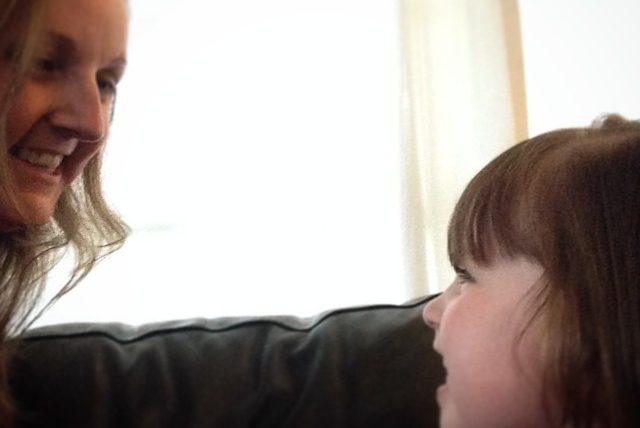
 Two weeks ago my daughter and I were really struggling. At 2.5 years old her primary mode of communicating with me was whining and yelling. And when she wasn’t whining and yelling, she would stutter, struggling against some invisible timer to get all her words out at once. She was frustrated most of the time. I was frustrated most of the time. Her yelling often woke her 8 month old sister which made the situation even more frustrating for me. I would try to respectfully acknowledge her feelings only to be buried in an avalanche of her anger and sadness. Things were not going well, but I felt powerless to change things. What could I do differently? I was listening. I was validating. I was setting clear and loving limits. Since birth I had worked with her on tools she could use to self regulate her emotions: deep breathing, visualizing a happy place, asking for space to be alone, accepting physical comfort (hugs or being held), requesting comfort objects, etc. But now she was rejecting my suggestions—instead becoming even more agitated! It was as if my help was making her more upset. In thinking about how to handle our communication problem, I realized that I was suffering from three major misunderstandings. When I made adjustments, our communication improved quickly and dramatically.
1. Make a distinction between behavior and emotion. Often my daughter would begin to cry and whine well before I had answered her question. Or she would ask the question by whining and crying, making it difficult to understand her. We would be frustrated before she even got to the request. I would say, “Please stop crying so I can understand you”—but that’s so confusing! I’m constantly telling her it’s okay to cry, that crying lets the sad out, and that it can make you feel better. How could I explain the difference? I realized that the difference is a simple one between behavior and emotion. With young children this can be very simple: “It’s ok to be mad but I won’t let you hit me.” Slightly older children can understand even more complex concepts: “It’s ok to be sad if I say no to your request, but I can’t understand what you are asking if you are whining or crying while you speak. Please ask me in a normal voice. If you are sad about the answer, then I can hold you while you cry.”
2. Let your child know you are listening. Really listening. I asked her about the stuttering. “Sometimes it sounds like all your words are trying to come out at the same time.” She nodded yes. I realized that she was eager for me to hear her words, and that she was worried I wasn’t listening closely or patiently enough. If a child thinks that you are impatient waiting for them to finish speaking or thinking about an issue that is important to them, they will become stressed. That stress can manifest itself in many ways including stuttering or lashing out in frustration. Slow down—be clear that you are listening and that you will wait. Give them the space they need to collect their thoughts and find a way to communicate. “When I hear that happening, I will kneel down like this.” I got down to eye level. “I will tell you ‘I’m listening’ and then I will be quiet and wait.” She looked at me skeptically. “That way you can stop, take a deep breath, think of what you want to say inside of your head first, and then tell me. I will just sit here and quietly wait for you to be ready.”
3. Acknowledgement and attention aren’t causing your child’s emotional reaction. It confused me why my daughter’s tear-brimmed eyes sometimes overflowed with full-blown sobs when I calmly asked, “Did that startle you?” I always thought I was being neutral, careful with my tone and body language, but somehow my acknowledgement seemed to make her more upset! Other parents distract their child and the kid seems to move on pretty happily. A kid at the park looks to his mother with a quivering lip after falling off the swing. She brightly says “Oops! You fell down. Let’s try the slide now!” and he picks himself up and has forgotten the fall before he even makes it to the slide. Was I teaching my daughter to overreact? If you distract your child, you aren’t teaching them how to deal with their emotions, you are teaching them to ignore their emotions. When you acknowledge a child’s emotions, they may have an emotional outburst. THAT’S OKAY! You haven’t made them more upset. They were already that upset; you just gave them a safe place to express their feelings. A child who is given the space to feel the full extent of their emotions and given tools to self soothe will learn how to regulate rather than suppress those feelings. They will not be afraid or ashamed of their emotions and then will learn proper outlets for them. They will be LESS prone to outbursts of inappropriate behavior because they will not be frightened and overwhelmed by their feelings. This realization has helped me to relate to her emotions in a healthy and confident way.
These three simple communication misunderstandings were causing us constant frustration and conflict. Today things between us have turned around so completely that I almost cannot believe it. We are communicating and working well together again.

Leave a Reply