– by Dawn Pedersen, M.eD.
Spoiler alert: this article shares a lot of the dialog and plot points of the movie Finding Nemo.
Yesterday I drove our little family to the coast and back, and during the drive, my three-year-old son watched Finding Nemo twice. Adding this up with the many other occasions I’ve watched or seen the movie, I’ve had an opportunity to appreciate this animated movie by Disney/Pixar on a new level. I now recognize that while it is fictional, and features cute colorful cartoons, it offers many lessons on why we should respect our children as whole, capable beings.
Our Fears Transfer to our Children
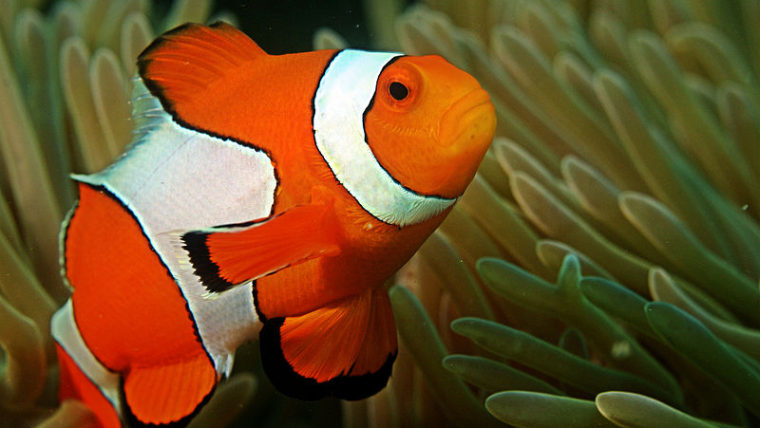
Marlin, a clown fish, is a single father of an only child. His wife died tragically when a predator attacked, leaving only one out of hundreds of eggs behind. The baby that hatches has an underdeveloped right fin, making swimming more of a challenge. Marlin blames himself for this entire situation because he had relocated the family just prior to the attack. In his guilt and fear, he begins to overprotect his son.
There, there, there. It’s okay, daddy’s here. Daddy’s got you. I promise, I will never let anything happen to you…Nemo.
On the morning of the first day of school, Marlin’s overprotectiveness is in full force. When Nemo has a small mishap as they get ready, Marlin starts regretting having agreed to let his son leave his side.
Nemo, don’t move! Don’t move! You’ll never get out of there yourself. I’ll do it.
When Nemo turns out to be fine, Marlin is still lacking confidence in his son. He asks Nemo if he’s sure he wants to go because it’s okay if he doesn’t. But Nemo wants to go. Marlin continues to drill Nemo that the ocean is not safe.
Respecting a Child Means Understanding that They Are Capable
Marlin’s apprehension is understandable, given the nature of his wife’s death. His love for his son is real and ever-present. However, Marlin demonstrates time and time again in word and action that he does not believe his son is capable and trustworthy. His son may feel secure with his father, but he does not get much opportunity to feel autonomous and competent.
This dynamic between Marlin and his son is what leads up to the first crisis in the film.
When Nemo finally frees himself from his father’s gaze to join his classmates, he starts making friends. Like youngsters often do, they begin to dare each other to do something a little risky. Nemo is about to refuse, stating that he’s been told it is not safe. When Marlin catches up, finds them doing something he decides is dangerous, and scolds his son, Nemo assures his father that he can swim fine. Marlin says something that we fear he has been telling his son many times in the past.
You think you can do these things but you just can’t, Nemo!
Kids Need Risk
While Marlin explains to the school teacher (a large manta ray) why he is pulling Nemo back out of school, Nemo starts swimming out into open water, away from the safety of the coral reef. He has been dared by his friends and told by his father he cannot. He is now very vulnerable. His father’s pleas and threats fall on deaf ears as Nemo is determined to touch a boat in the distance before returning.
This is the level of rebellion we often see in young people who have been prevented from taking small risks all their lives. All kids need risk if they ever hope to develop risk assessment skills. If they don’t get it regularly, they have a difficult time determining when something is truly dangerous.
Suddenly, on the way back from touching the boat, Nemo is caught by a diver in a net and carried away.
Nemo and his father are separated for the majority of the movie. While each is in danger for much of this time, Nemo now has the opportunity to learn how to be capable and have confidence in himself. Marlin learns a few lessons on the way too.
Persistence is Vital
When Marlin teams up with a Blue Tang named Dory, she provides comic relief along with one of the key messages of the film.
Just keep swimming, Just keep swimming.
This theme recurs, that you need to keep swimming when life has got you down.
Give Kids a Chance to Get Out of Whatever They Got Themselves Into
Meanwhile, Nemo has ended up inside an aquarium in a dentist’s office. When he gets sucked into and stuck in the filter’s intake tube, he cries out for his father. One of the older fish, a Moorish Idol names Gill, tells him he can get himself out.
GILL — I just wanna see him do it, okay? Calm down. Alternate wiggling your fins and your tail.
NEMO — I can’t. I have a bad fin.
GILL — (Showing his own injured fin.) Never stopped me. Just think about what you need to do.
Of course, Nemo does manage to wriggle free on his own. He just needs the support and encouragement from a grown-up. Later, Gill and the other tank fish provide Nemo with a fearsome coming-of-age ritual that helps Nemo throw off some of his feeling of incompetence.
Failure Is Just a Step on the Way to Success
After the ritual, in which Nemo is accepted into the aquarium clan, Gill explains an elaborate plan for Nemo to escape so he can avoid being killed by the dentist’s reckless niece. The plan requires Nemo to play a critical role because he is the only one small enough to fit into the filter.
Gill has faith in Nemo’s ability, so Nemo does too.
Nemo fails the first time around, but a little later when time is of the essence, Nemo tries again.
Playfulness Can Help Us Deal with Difficult Times
Marlin and Dory face danger when they become surrounded by jellyfish in open water. Marlin concocts a game, a race, bouncing across the top of the jellyfish to reach safety.
So, we’re cheating death now. That’s what we’re doin’. We’re havin’ fun at the same time. I can do this, just be careful.
Marlin tames his own fears and shows his forgetful new friend how to survive in a very tense situation.
Often in parenting we get very serious when something goes awry, when we feel challenged by our children. The last thing we feel like doing is being playful. But sometimes it’s just what everyone needs, to ease the tension and bring proper perspective back to a situation. What might have resulted in everyone feeling awful suddenly brings joy because one person brings a spark of playfulness into the moment. We remember that we all love each other and that that is the utmost purpose of our family, not petty power plays. Usually what happens is children agree to what we need them to do after all, because we have filled them with a sense of belonging and lovableness.
When We Have a Lack of Faith in our Children, They Have a Lack of Faith in Us
GILL — You miss your dad, don’t you, Sharkbait?
NEMO — Yeah.
GILL — Well, you’re lucky to have someone out there who’s lookin’ for you.
NEMO — He’s not looking for me. He’s scared of the ocean.
Luckily, later on Nemo hears from a pelican on the windowsill how his father has risked his life many times to find him, and Nemo musters the courage to try the dangerous escape plan again. This time, he succeeds in disabling the filter with a carefully-placed pebble.
Kids Who Are Trusted Will Amaze Us
Marlin and Dory are taken in by a bale of sea turtles in the East Australian Current. Crush, a father turtle with the aspect of an aging surfer dude, holds Marlin back when Crush’s tiny son named Squirt gets caught up at the edge of the current.
CRUSH— Whoa. Kill the motor, dude. Let us see what Squirt does flying solo.
SQUIRT — (Returning.) Whoa! Whoa! That was so cool! Hey dad, did you see that? Did you see me? Did you see what I did?
CRUSH — You so totally rock, Squirt! So give me some fin…noggin…duuuude.
And some additional wisdom from this 150-year-old reptile:
CRUSH — Curl away, my son. Aw, it’s awesome, Jellyman. Little dudes are just eggs, leave ’em on the beach to hatch, then coo-coo-ca-choo, they find their way back to the big ‘ol blue.
MARLIN — All by themselves?
CRUSH — Yeah.
MARLIN — But-but-but dude, how do you know when they’re ready?
CRUSH — Well, you never really know. But when they’ll know, you’ll know, you know? Ha.
Crush trusts his son to do things when he feels ready to. Crush also trusts his small son to lead a group exit from the rushing current.
A Child Overprotected Is a Child Missing Out on Life
Dory decides to ask a whale for directions, which frightens Marlin. He starts to panic. Dory tries to reassure him that it’ll be okay.
MARLIN — No. I promised him I’d never let anything happen to him.
DORY — Huh. That’s a funny thing to promise.
MARLIN — What?
DORY — Well, you can’t never let anything happen to him. Then nothing would ever happen to him. Not much fun for little Harpo.
Parents at the playground tell young ones that they are “too little” for this or that play structure, when it is not likely to be true. Children are kept from bicycling around the neighborhood or walking to school because there in the infinitesimal change that they will come to harm. Our children are capable of so much more when we give them the tools of good judgement and risk assessment that come with letting them do things on their own. They are living life now, not merely waiting to live it when they are grown.
This is my husband trusting our 3-year-old son. Notice how the boy says, “Don’t catch me!”
Trust Your Kids to Solve Problems
Nemo manages to escape into the open sea. Marlin and Nemo find each other with Dory’s help. Dory gets caught up in a fishing net, and Nemo is determined to save her.
NEMO — Dad! I know what to do!
MARLIN — Nemo! No!
NEMO — We have to tell all the fish to swim down together!
MARLIN — Get out of there, now!
NEMO — I know this will work!
MARLIN — No, I am not gonna lose you again!
NEMO — Dad, there’s no time! It’s the only way we can save Dory! I can do this!
MARLIN — You’re right. I know you can.
In a final scene, Marlin is ready to send his son off to school, bravely telling him to go have an adventure. It’s awesome.

lol I forgot about the Nemo line, “He’s not looking for me. He’s scared of the ocean.”
I think you found all the lessons! 🙂
Awesome analogy, Tiki Mama! Great post!
Great post!
“Well, you can’t never let anything happen to him. Then nothing would ever happen to him. Not much fun for little Harpo.” I LOVE this quote. very RIE 🙂