– by Amanda Barnes Cook, P.hd
Even for parents with no intention of introducing a pacifier (whether to give the child the chance to learn to self-soothe, or to allow for the best breastfeeding outcomes), the difficulty of Real Life often intervenes. For us, Real Life reared its head on the first night of our son’s life, when he was placed under phototherapy lights for mild jaundice. The nurse told us, “We are a Baby Friendly Hospital and do not provide pacifiers because they can interfere with the establishment of breastfeeding. But unofficially, every baby under phototherapy lights should really have one. It’s the only thing that will comfort them.” If you’re unfamiliar with phototherapy lights, the baby is placed on a hard plastic bed in a diaper and a little eye mask. There is no cuddling. It is a newborn torture machine. After getting reprimanded by nurses for trying to hold him while placing him under the lights, we gave him a pacifier. Instant relief. And thus began three years, almost to the day, of an intense pacifier love affair.
At first, pacifiers are cute and mostly unproblematic. There is some annoyance caused by inconvenience. For example, the pacifier falls out of the unskilled sucker’s mouth so often that it seems to defy the laws of physics. They seem to get lost all too often, which is easily remedied by buying dozens and keeping them around the house in strategic locations. Later, there is the annoyance of a happily sleeping baby in a crib who wakes up needing nothing but the pacifier, which has fallen through the bars of the crib and to the floor. (“Should I go pop it back in, or you?” my husband and I would often say.) The pacifier-loving baby in infancy often acquires the pacifier as a literal appendage—hanging off his or her clothing on a little tether, ready for use at any moment, safe from the germs of the floor.
For us, this view of pacifiers as great, if mildly inconvenient, started to change when our son was about a year and a half old. Suddenly, he seemed more like a toddler, and less like a baby. The pacifier seemed slightly inappropriate, out of place. As he began to speak, the pacifier muddled his words. Instead of others thinking it cute, we now seemed to sense that they thought he was “getting too old.” The pacifier, we now realized, was going to have to be gotten rid of. But how?
From this first change of perspective about the pacifier, I knew that I wasn’t willing to just take it away. The pacifier was his method of self-soothing. To take it away by force seemed cruel. We had expected the pacifier to help him cope with sadness, frustration, and separation for so long, and now we would inflict sadness and frustration on him by taking it away? The dominant pacifier narrative of our culture started to creep into my subconscious. But what about his teeth? I thought. But what about his language development? Around age 2, we decided to limit his pacifier use to the upstairs of our house, but not to limit his use of it beyond that. If he wanted it, he could have it at any time, but only if he was willing to go upstairs to get it. We sat down for a little family meeting, explained the new rule, and enjoyed a relatively seamless transition to having pacifiers only upstairs. (Of course, he tested limits. He would try to sneak downstairs with it while covering his mouth, or hide under the table with it. We would joke about it, and then calmly enforce the limit. If he was sick or especially sad, we would tell him, “You can have an exception and bring it downstairs.” Soon thereafter he started asking us to “Make an exception, mama!” In short, our pacifier rule provided all sorts of good lessons in learning about how limits work, and I dare you not to smile when a two year old asks you to make an “exception”!)
After 24 months, I started thinking more and more about the inevitable End of the Pacifier. How were we going to do it? How were we going to take it away? I started researching parenting strategies for “respectfully” taking away the pacifier. All of them immediately struck me as profoundly disrespectful. One oft-used strategy suggests having the Paci Fairy visit the house to take away the pacifiers and leave a gift. Another suggests forcing the child to “give” his or her pacifiers to a newborn who “really needs them.” But what lessons is this teaching? Most prominently, taking away the pacifier is telling your child that they are “big” and can no longer be the baby. It tells them you don’t trust them to give it up in their own time. It tells them you don’t believe they have the skills to grow without being forced to. It tells them you don’t think their self-directed timeline of readiness is adequate. It tells them that their needs are illegitimate. It teaches them to redirect their anger at this loss (which, in their small lives, is a pretty profound loss) at another object—the Fairy, the unsuspecting newborn who just became a thief. It teaches them to substitute a gift for their grief. “Don’t feel bad, here’s a toy.” I know that the intentions of parents who use these methods are good. But we need to consider the implications.
I read that most children give up the pacifier on their own between the age of 3 and 4. At two, at two and a half, at two and three quarters, I simply could not believe that my son would ever willingly give it up. It made me anxious. It made me feel like a failure. Our doctor would ask about pacifier use and I would mumble an answer and try not to seem like a permissive parent whose actions were allowing her son to develop lifelong tooth problems.
And then I made what seemed to be a radical decision. I would trust my son. End of story, that’s my plan. Trust my son. With dozens of pacifiers in our house, we would take no more action. We wouldn’t buy more, but we would take no positive steps to wean him.
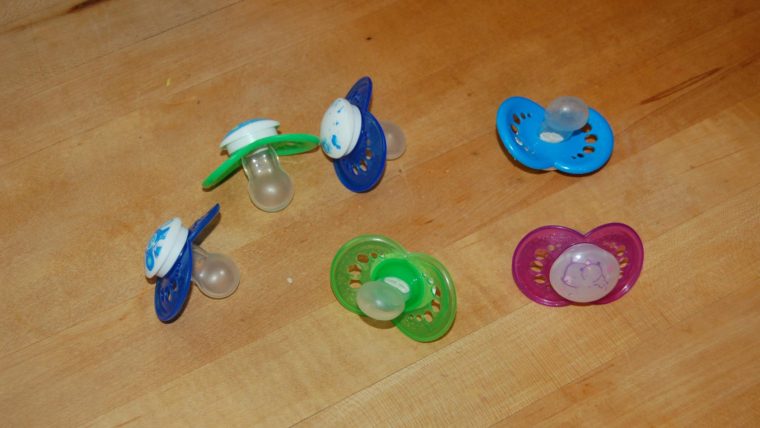
As age 3 approached, he slowly became uninterested in pacifiers with cracks in them, whereas before he would suck them intently no matter their condition. Instead of hoarding as many as he could locate, he started seeking out the uncracked ones. One day he told me, “We should give my cracked babas away to kids who like cracked babas.” Another day, I watched him throw a cracked pacifier away. “You know, we’re not going to buy any more pacifiers. If you throw it away, the garbage truck will take it away and it will be gone.” He thought, and then took it out of the trash and asked me to wash it. On his third birthday, as the number of uncracked pacifiers had dwindled to one, he couldn’t locate the uncracked one, and sat in bed sucking on a couple cracked ones that we had found. The look in his eyes said, “It’s just not the same.” He sighed, threw them on the floor, and said, “I don’t like babas these days.” He fell asleep that night without a pacifier, for the first time ever. Later that night, he woke up, in a frenzy. He was half asleep, but it was clear he wanted a pacifier. I managed to find the last pacifier, and when he started sucking on it, he immediately fell back into a deep sleep.
The next morning, I noticed a crack in the last pacifier. Later that day, we couldn’t locate it. This is it, I thought. What is going to happen?! All my old anxieties bubbled to the surface. At bedtime, he couldn’t find the pacifier, and lay in bed with three cracked ones. I lay with him, even though we don’t usually stay as he falls asleep. That night, as he struggled to fall asleep, I watched him grow up a little bit. He tried sucking on each one, and spit each out. He lined them up in front of his mouth like a little train. He tried to hug them like a bear. He tried, in a last ditch effort, to suck on the backs and on the sides. Finally, he sat up, pulled up his pillow, put the pacifiers under the pillow, put the pillow back, took a deep sigh, and fell asleep.
He has not mentioned his pacifiers again. For three nights, he woke in the night and needed some comfort to fall back asleep. And that was it. All my anxiety, all my worry. It was him—all him. And it was beautiful.

Thank you for sharing! I am feeling all the same nervousness and my DH and I have also decided to trust Baby Girl. We only have three (3) left and she is about to turn 2. I hope we find the same success as you.
This gives me hope for the future. We trusted my son to give up his thumb, it worked. When the time comes we will trust my daughter to give her dummy up. Thanks for sharing.
This is priceless to me. I have a girl who loves her binkies and needs five or six or as many as she can get at night. Her caregivers who aren’t me try to limit them, but I honestly do not care. She’s smart enough to know she wants them and, to me, it doesn’t make that big a difference. Like you said, I want to respect her. I want her to motivate herself. And I do not want her to have to grow up any more before she’s ready.
Thank you so much for this post. It echoes, almost perfectly, my worries about the pacifier, and gives me hope for the future (my son is at that 2 1/2 age where I can’t imagine him functioning without his paci – especially sleeping).
I wonder if you have any advice for me. The pacis we use become unsafe when they start to crack/rip – the way my son chews them, the next step after cracking is the tip of the nipple detaching, and I’m afraid my son would choke on the part that detached. So I periodically throw away the cracked pacis and replace with new ones. But eventually we’re going to have to not replace them, and I’m just not sure how to do it, as we won’t have the not-so-satisfying pacis around.
Great story! We were lucky with our first in that she bit through her pacifier so much that it was hanging by a “thread” which we deemed “unsafe” for her to suck on anymore and we threw it away together because it was “broken” and there weren’t anymore in the house. But along the same lines as written about here, my policy is–when my child turns 1, the pacifier is restricted to the crib/bed–so only at naps and bedtime. It’s worked well so far. Thanks for sharing!
AMAZING POST!!!! I LOVE IT!!!!! What a great read for me this morning! I totally agree with all of what you said!
Thank you for this post !!! I felt miserable, but your post has given me hope.
I’m glad! Let me know how it goes!
Thank you for writing this. Just came back from my 2.5 year old’s dentist appointment where they told me like they have every time “you need to get him to stop taking a pacifier.” She then proceeded to tell me how to give him snacks or toys or books in the car instead of his pacifier or to just have him increase increments of time that he’s not using it so he’s making progress. She said it needed to be done by age 3 when the jaw would be making permanent motions based on his sucking habit. We tried to wean him from his car pacifier before but he started sucking his fingers as a replacement. I’d rather he suck a paci than his fingers which are always with him! He and his little brother (9 mo) share a bedroom, so peaceful sleep is extra important around here. You’ve calmed my worries and helped me stay to the attachment parent approach that we wanted to begin with!
Loved this story. It’s funny how becoming a parent changes your perspectives. Especially on the toddler with a pacifier topic. My son is 2.5 and uses it for bed and nap and as much as I want him to stop I get really sad thinking about it. I find it cute how excited he gets when he finally gets it for bed time. Yayyyy and does a jump… my baby is growing up. Ugh! I’ve been debating putting a pin hole in the tip of his mam pacifier. He’s got 3 left.
Thank you! It’s beautiful hard, isn’t it?!
I have four grown children. No parent should worry about taking their childs pacifier. All my children except one sucked a pacifier past three years old. The three that sucked pacifiers never had a cavity or crooked teeth. The one that didnt have a pacifier had to have braces. Dont listen to the hog wash that doctors and dentists tell you. Because that’s what it is…hogwash.
My son is about to turn 4 in February. We have limited the use to mainly in the morning and at night or for nap. We told him he could use it in his room during the day but that’s where it would have to stay. Similarly he tries to sneak it and we are down to 2 one is a little cracked but he doesn’t seem to care. I want to trust he will give it up as he has made all other transitions this way but he doesn’t seem to be giving them up. Your post gives me hope but is there anything I can do to speed up the process? Maybe talk to him about getting rid of the cracked one because it’s not safe? We havnt bought any new in over a year. Still he maintains these two and rotates between them. Just at a loss right now on how long this will go.
What do I do if my child has stopped his pacifier completely at my house over a year ago and then goes over to his other mother’s house and still uses one? We have even told her that he no longer uses one at our house and she told us that he has stopped at her house also. She came to pick him up the other day and he was hiding in the back of her car with one in his mouth.