
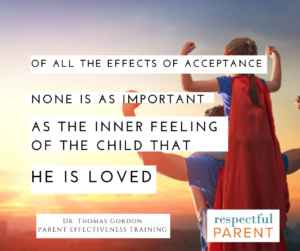
One of the most powerful gifts we can give our children isn’t correction, advice, or even praise. It’s acceptance.
When I shared that idea recently, it resonated deeply with a lot of parents. And it also surfaced a common worry I hear all the time:
“But if I accept my child, doesn’t that mean I’m letting bad behavior slide?”
Short answer: no.
Longer answer: let’s talk about what acceptance really means in Parent Effectiveness Training (P.E.T.).
What Acceptance Is (and What It Isn’t)
In P.E.T., acceptance is not permissiveness.
It’s not ignoring behavior, lowering standards, or saying “anything goes.”
Acceptance is about separating who your child is from what your child does.
When children feel accepted as they are, they feel emotionally safe. And when they feel safe, they are far more open to learning, cooperation, and growth.
Acceptance sends a powerful message:
“You are loved—even when your behavior needs work.”
That message sinks deep. It becomes a quiet inner voice:
I matter. I’m okay. I belong.
And that inner feeling?
It really does change everything.
“Okay… But What About the Behavior?”
This is where many parents get stuck.
Because yes, there are behaviors we don’t like. Doors get slammed. Voices get raised. Shoes get left in the middle of the hallway again.
Acceptance doesn’t mean pretending those things don’t matter.
It means responding with the right tool at the right time.
When Your Child Owns the Problem
Let’s say your child yells, “You NEVER understand!” and storms off, slamming the door.
In that moment, your child owns the problem. They’re overwhelmed, upset, and signaling emotional distress.
This is where Active Listening comes in.
Instead of lecturing or defending yourself, you might say,“It sounds like you’re feeling really frustrated and unheard.”
You’re not agreeing, you’re not fixing. You’re letting them know they’ve been understood.
That’s acceptance in action.
When You Own the Problem
Now let’s say that slammed door rattled the house, startled you, or left you worrying about damage.
That’s when you own the problem.
Later, when emotions have settled, you can use a clear I-Message,“When doors get slammed, I feel tense and worried. I need us to handle anger without damaging the house.”
Same situation.
Different moment.
Different skill.
This is what healthy parenting looks like. Acceptance and limits, working together.
Why Skills Matter
Most parents already care deeply. What they often lack isn’t love or effort, but practical tools they can use in real-life moments.
Parent Effectiveness Training is about putting theory into practice. We learn:
-
How to recognize who owns the problem
-
What to say when emotions run high
-
How to set limits without damaging the relationship
-
How to grow the “no problem” area in your family life
And we practice. Together. With real examples. So you’re not guessing in the heat of the moment.
You Don’t Have to Choose
You don’t have to choose between being loving and being effective.
You don’t have to choose between acceptance and accountability.
You can be both.
And when you are, parenting feels less like constant damage control and more like a relationship you can actually enjoy.
If this idea of acceptance speaks to you and you’re ready to dig deeper, my next Parent Effectiveness Training course begins soon:
☀️ Tuesday Mornings
🗓️ February 17 – April 7
⌚ 10:30 am – 1:30 pm (Pacific)
You don’t have to do this perfectly.
You just have to be willing to learn something new.
And that, too, is acceptance. 💛
Here are some other articles you may like:
Why Connection Isn’t a Reward for Rude Behavior
What Setting Limits Looks Like
I’ve recently added something new! Leader Effectiveness Training translates beautifully between home and work, and many employers will invest in it (it’s recognized by SHRM to offer Professional Development Credits (PDCs) for SHRM-CP® or SHRM-SCP® recertification activities).

Leave a Reply