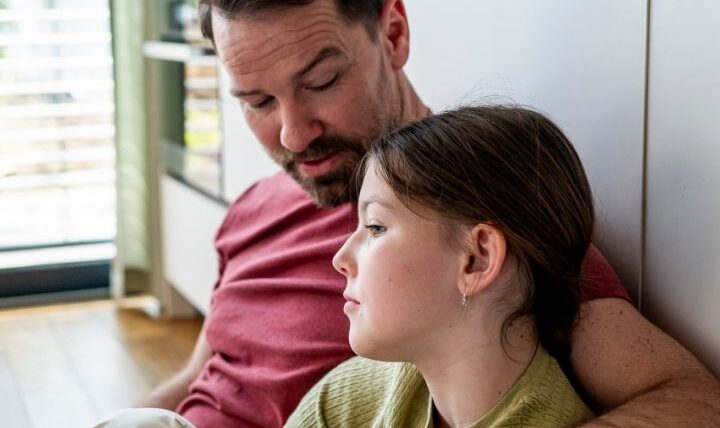
Do you ever have one of those mornings where everything feels a little heavier? Maybe it’s just me, but it’s not because of one particular parenting conversation or one particular thing my kids did, but because of a feeling I couldn’t quite shake. I think it’s the general feeling of unrest and uncertainty in society right now. Sometimes it just seems like empathy is slowly disappearing, and I’ve found myself wondering: Do we still care about empathy?
I mean, of course we as parents do, but in general it seems to have taken a back seat, and I think that is making us so, so tired. I teach active listening, and there are plenty of times when I don’t have the energy to really do it. Not just hear my child’s words while I’m mentally preparing my response, but actually slow down and become curious about what they’re experiencing. Sometimes I don’t want another complicated conversation.
Maybe We’re All Tired
Parents are getting so much at all times – school, sports, homework, schedules, social media, work, money, technology, and teenagers who sometimes seem to communicate exclusively through sighs and one-word answers. We’re trying to keep up with everything while also being told we’re supposed to raise emotionally healthy, resilient, independent, confident human beings. No pressure.
Maybe we’re tired, maybe we’re overwhelmed, maybe we simply don’t have much left to give at the end of the day, and when we’re exhausted, listening can feel like one more thing we’re being asked to do when what we really want is for everyone to just cooperate for five minutes. But here’s the part I keep coming back to: when I do have the energy to really listen, something happens. My child feels heard. Sometimes they soften. Sometimes I soften. Sometimes they tell me something they weren’t going to tell me. Sometimes the problem becomes easier to solve because we’re no longer fighting about who is right. And sometimes nothing gets solved at all, but there is simply a little less distance between us.
Almost every time, I walk away feeling something I didn’t expect: I feel connected, I feel like what I did mattered, and I feel a little more energized and hopeful about parenting.
Understanding Doesn’t Mean Agreeing
This is one of the most important things I teach in P.E.T.: understanding someone doesn’t mean agreeing with them. It doesn’t mean saying yes, approving of the behavior, giving up your own needs, or allowing your child to do whatever they want. It simply means being willing to say, “There is something about your experience that I don’t understand yet, and I’m willing to listen.”
Our kids can be angry, disappointed, unreasonable, frustrated, scared, or completely convinced that we are the worst parents who have ever walked the earth. We don’t have to agree with their conclusions to understand their feelings. Sometimes being understood is exactly what helps a child move through those feelings. This is where P.E.T. can feel so different from some of the traditional parenting advice we’re given. We’re not trying to win the argument or make our child see things our way. We’re trying to understand what is happening for them while also remaining honest about what is happening for us.
What Happens When We Stop Listening?
I think about this a lot as a P.E.T. instructor. What happens when our children learn that bringing us a problem automatically gets them a lecture, a solution, a warning, or a lesson? What happens when they stop expecting us to listen and start expecting us to react? They may stop coming to us. Not necessarily because they don’t need us, but because they don’t expect to be understood.
That doesn’t mean every conversation needs to become a 30-minute therapy session. Please tell me that’s not the requirement. 😂 Sometimes active listening is simply slowing down enough to say, “That sounds really frustrating,” or “You really wanted that to work out differently,” or even, “Tell me more.”
We’re not solving the problem in that moment. We’re not giving advice. We’re letting our child know that we’re here, we’re listening, and their experience matters to us. Sometimes that little shift is enough to change the entire direction of a conversation.
Curiosity Leaves Room for Understanding
I think curiosity may be at the center of all of this. Curiosity says, There is something I don’t know here. It asks, What am I missing? It leaves room for the possibility that our child has an experience we haven’t considered, even when we don’t agree with their conclusion.
And honestly, parenting gives us approximately 47 million opportunities to practice this. A child comes home slamming doors. A teenager says they don’t care. A sibling is furious because someone looked at them “wrong.” Our first instinct might be to shut it down, but what if we got curious instead? What’s going on? What happened? Tell me more.
Not because we’re trying to interrogate them, but because we’re trying to understand them. Sometimes that curiosity gives our child enough room to figure out what is actually bothering them, and sometimes it gives us information we never would have gotten if we’d jumped straight to fixing the problem.
The Courage to Know the Difference
I don’t have a grand solution to all of this. I still get frustrated and tired, and I still have moments when I’m more interested in getting my point across than understanding what is happening for the other person. I’m a parent, after all, and I’m also a person trying to navigate my own work, worries, relationships, and whatever the world happens to be throwing at me that day.
But every once in a while, I have one of those conversations where I can actually feel the shift. My child says something, I listen instead of fixing, and they realize I’m not going to argue with them or immediately tell them what they should do. They keep talking. Maybe they share something they weren’t going to tell me, or maybe nothing about the original problem has changed, but somehow we feel like we’re on the same side again. That little spark of connection reminds me why I believe these skills matter, even when the world feels noisy, exhausting, and completely overwhelming.
And lately, I’ve been thinking about something else. When we practice empathy with our kids, we aren’t just making things a little easier at home. We’re helping shape how they will treat other people when they leave our homes and step into the world. When children grow up experiencing what it feels like to be heard, respected, and understood, they have an opportunity to learn how to offer those same things to others. They learn that someone can disagree with them and still deserve to be listened to, that conflict doesn’t have to mean someone wins and someone loses, and that another person’s feelings and needs matter, too.
We can’t control the world our kids are growing up in, but we can help them develop the skills to navigate it with empathy, curiosity, and respect. And in a world that often feels so divided, angry, and quick to dismiss people who think differently, that feels pretty darn important to me.
My Big WHY
I don’t think parents need another lesson in how to be perfect, and I can’t control what the world is throwing at our kids. There is nothing I can do about technology, politics, AI, social media, the economy, or all the other things that will shape their lives. I certainly can’t control everything happening in my own life, either, but what I can do is keep working on how I show up in the relationships that matter most to me.
I can remember that acceptance isn’t permissiveness, listening isn’t agreeing, and setting limits doesn’t have to mean creating a power struggle. I can remind myself that my child can own a problem without me abandoning them in it and that I don’t have to get it right every time. Neither do you. Sometimes I give advice when I meant to listen or try to solve a problem that isn’t mine to solve. Sometimes I’m more interested in being right than being curious—then I get another chance. Parenting is full of those!
Maybe that’s what I want P.E.T. to give parents most of all: not a magic formula for peaceful parenting, because I’m pretty sure nobody has invented that yet, but another way to approach the moments that happen every single day. A way to pause before reacting, get curious before assuming, and listen before fixing. Because underneath all the homework, schedules, technology, sports, college worries, work stress, and endless noise of the world, there is still a relationship happening. And those relationships are where our kids get to experience, practice, and learn what empathy looks like.
I think about the kind of world our kids are going to inherit, and I worry about it, just as I worry about so many other things. But I also think about the kind of people they can become and the difference they might make in their own families, friendships, workplaces, and communities. Every time we choose to listen instead of dismiss, get curious instead of judge, or work through a problem without turning it into a battle, we are doing more than getting through another parenting moment. We are helping create a generation that knows what it feels like to be understood and has a better chance of offering that understanding to someone else.
And that feels worth fighting for.
I’m going to keep working in my little corner of the world, even on the days when it feels like I’m shouting into the void, because I still care about empathy, I still believe connection matters, and I believe the way we treat our kids today can make a difference in the world they create tomorrow. I hope I’m not the only one.
You may also like: Why I Don’t Spank, Punish or Bribe My Kids
Want to learn more? Check out my P.E.T. and L.E.T. class schedules
I am now offering Leader Effectiveness Training so you can bring this respectful way of communicating into more areas of your life.

Leave a Reply