– by Tara Kreitz
As my son grew through babyhood and into toddlerhood, I began learning about a respectful approach to feeding that really resonated with me: Ellyn Satter’s Division of Responsibility (DOR), also championed by Castle & Jacobsen in Fearless Feeding.
The idea was simple: the parent has certain responsibilities—what food is offered, where, and when (depending on the child’s age, of course); and the child has others—whether and how much to eat. Both roles are clear, so there are no power struggles. The combination of predictable structure and freedom makes meal times enjoyable and comfortable, which paves the way for a healthy relationship with food. It seemed like a great alternative to the power struggles, shaming, and bribing with which I had grown up.
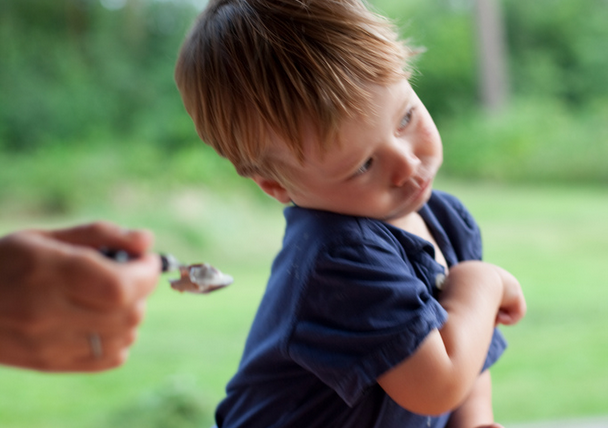
The more I learned about the approach, the more I liked it; however, I also became increasingly worried about how it would look in my family. My son, at the time just over a year old, had not taken to solid food. We had tried purees and table foods, and he turned his face away in disgust at all of it. Table foods were worse because generally he wouldn’t even bring them to his mouth; any food that was not completely dry and firm, he would start to pick up, make a sour face, and put back down. We could usually cajole a jar or two of puree into him per day, but he didn’t like it. Sometimes he fed himself a few Cheerios. He would rather have survived entirely on milk.
The DOR approach to feeding calls for trusting one’s child, and I was afraid that my son could not be trusted. The common wisdom is that children won’t starve themselves; if they’re hungry, they’ll eat. I felt deep down that this was not true for my son. He was highly sensitive and always knew exactly what he wanted and didn’t want—and he just didn’t want food.
But, of course, he needed to eat. So, I fed him on demand, alternately offering milk and solids. I made sure he knew that food was always there. I felt like I was spending all day trying to feed him, and he was spending all day refusing food. He would eat a few bites and then declare himself all done. He could say the word “milk” and would ask for milk whenever anything else was offered. And I would acquiesce.
At 15 months old, my son moved from the infant room at his daycare, where the babies were fed on demand, to the much more scheduled toddler room, where there were two sit-down snacks and one meal per day. It was all perfectly DOR-consistent: the children sat at the table and fed themselves, and the teachers provided unlimited helpings of food and did not pressure or comment on what the children were eating. Milk was given only at meal times and was limited to 4oz per meal.
When I sat with my son at morning snack on his first day in the new room, I couldn’t believe my eyes. The other children were, well, eating. They were quite enthusiastically putting food in their mouths, and they were enjoying themselves. I had never seen my son do that before. As his peers ate, my son sat silently and watched them without touching or even looking at his own food; then he took his spoon and deliberately scooped his food onto the table. It was as if he didn’t even realize that food was for eating. The contrast between him and the other children broke my heart.
I knew that something about our current approach to food was not working. What should I do? On one hand, the DOR was the only thing that made sense to me. On the other hand, trusting my son seemed scarier than ever. What was happening at daycare confirmed my sense that he would rather starve than eat food he didn’t like. I would pick him up in the afternoon, and the whole way home he would cry from the back seat, “Milk. Milk. Milk.” And yet, there was no medical issue—I had spoken with our pediatrician about my son’s eating, and he reassured me that my son was perfectly healthy. Was this really a child who could regulate himself?
Fortunately, I decided to take the leap and find out.
I hadn’t been doing a bad job of feeding him—I was giving him the final say on whether and how much to eat, and I was avoiding power struggles—but I had to fix a few key details:
- I took charge of the “when” and stopped offering food between scheduled, sit-down meal and snack times (about every 2 hours). That way, he had an appetite when he came to the table, but he never got too hungry. If he wanted to eat outside these times, I acknowledged that he wanted to eat and told him that it would be time to eat again soon and I would help him wait. And no more snacks on the go; even outside the house, we always sat down and focused on eating until he was done.
- Whenever possible, my husband and I ate at the same time our son did, and we offered him what we were eating, even if we were certain he wouldn’t like it. (Maybe he would surprise us!) At the same time, at each meal I also offered at least one thing he generally liked, so I knew he wouldn’t go hungry. I asked his daycare teachers to do the same.
- I offered milk only three times a day (breakfast, lunch, and before bed); at first I also offered 4 oz at each snack time, but I stopped that after a week or two. That way, he wouldn’t always be able to fill up on just milk.
- And, most importantly, NO MORE PRESSURE. I stopped saying things like “Don’t you want a few more Cheerios?” and “Are you sure you’re all done? You didn’t have very much food”…and even “Wow! I’m so happy to see how much you ate today!” Instead, I said nothing about what he was eating or not eating. From then on, all I said about his food was to tell him what was on offer, to ask him whether he wanted more of something when he’d finished his portion, and to confirm when he was all done. Other than that, I spent my time conversing — not about food — and chewing.
Something magical happened: my son started to like food.
The first week or so of our new experiment, not much actually changed, but I at least felt good about having a plan and a structure.
Then, we started to experience miraculous moments that almost made me fall out of my chair with excitement. My son tried—and liked—scrambled eggs, peanut butter, tofu, pasta with tomato sauce. One time, he asked for some of my steel cut oatmeal, and when I put some in a bowl for him, he reached in and started eating with his hands. And then, of course, there was the moment he first fed himself with a spoon. I had feared that he would never be motivated enough to learn how. His perseverence at an initially challenging food-related skill was a testament to his new enjoyment of food.
It became clear to me just how anxious and confused he must have felt about meal time. No wonder he wasn’t interested in food. For one thing, food was new, sometimes it felt mushy or messy, and there was no telling how it would taste. And then there we adults were, maybe not saying anything too harsh but staring at him hopefully, desperately, always wanting and expecting and worrying. It must have felt so complicated and heavy.
My son still has a limited palate. He does not eat like the average child his age. But he enjoys eating, wants to eat, and feels comfortable at meal times. He often tries new things and sometimes likes them. He’s healthy and his growth is steady. He doesn’t get enough iron in his diet, but there’s a supplement for that.
Trust is scary—especially when what’s at stake is the health of a little person you love very much. But trusting children is the only way to show them how to trust themselves. It wasn’t until I trusted my son that he showed me that he was up for the challenge.

Thanks for sharing your story and mentioning of my book, Fearless Feeding. Trusting children with food (especially when they are more picky or big eaters) can be tough, but as you point out it is well worth it. I tell parents to think of eating like other learned skills like reading and writing, it takes time, patience and supportive environment for children to learn to eat a variety of food. And each child learns at their pace. Glad your little one is enjoying eating!
Thanks, Maryann! I really appreciate all that you do to help families achieve healthier and more enjoyable meal times.
Hi Maryann, I’d love to know more about your book – are you on twitter? My book about picky eating (War & Peas) was out earlier this year, maybe we can do a swap!
solving picky eating
Great post – yes – DOR makes total sense and trusting your child is hard when you are anxious about her health. You describe getting your child’s health checked by a professional. When I work with families of picky eaters, that’s my first piece of advice. If a child is healthy and growing as expected, there is no reason why you can’t trust them to make their own decisions about their eating.
solving picky eating
Great stuff! Will be sharing with parents I work with. !
This is interesting! I don’t have kids yet, but I know that I really want to help them cultivate a healthy relationship with food. Thanks for this article, I’ll have to find that book!
I can not thank you enough for posting this article! I can proudly say that my two year old son eats his vegetables, tries new foods on a consistent basis and mealtimes are relaxed and fun. I stumbled across this article when we were just introducing solids. I have friends with *picky eaters* and, quite frankly, am horrified by their lack of good nutrition and I wanted to avoid problems before they started. These tips gave me the confidence to trust my son, and my self. I often times notice that my son will eat a ton of chicken and only a few bites of vegetables. The next day, it will be the complete opposite. I have learned to look at what he eats in a 24 period and not panic over each meal. He knows it is OK to say “no” and to take food out of his mouth and put it back on the plate if he does not like it. If he does not like, or try something, I keep offering it to him, but never bribing, forcing or making an issue out of it. It is simply on his plate. Again, thank you!