Next Course Starting June 16th. Sign Up!

Respectful Parent

Parent Effectiveness Training, San Diego Parenting Classes

  • Home
  • About Kelly
    • Parenting Philosophy
    • What You Will Learn
    • Testimonials
  • Services
    • Classes & Workshops
    • Personal Coaching
    • Speaking Engagements
  • Resources
    • Parenting Books
    • Children’s Books
    • Thoughtful Independent Play Toys & Gift Guide
    • Awesome Parenting Gear
  • Free Consult
  • Contact
  • Blog
  • Privacy Policy

Book Review: It’s OK Not to Share

May 28, 2014

– by Dawn Pedersen, M.eD.

Have you ever found yourself in a group of other parents, playing with your children, and peer pressure alone makes you direct your child to do something, or avoid something? And then you wonder whether that was really the best thing for your child, or if you’re just reacting to the presumed expectations of other moms and dads. Sometimes we coax our kid to share something she’s enjoying, or to apologize for an action he doesn’t really understand. Sometimes we remind our child not to climb the slide, or not to exclude another child from play. If you ever had the gut feeling that maybe that wasn’t really a useful approach, you may be right.

It’s OK Not to Share and Other Renegade Rules for Raising Competent and Compassionate KidsHeather Shumaker has put together 29 “Renegade Rules” in her parenting book entitled It’s OK Not to Share and Other Renegade Rules for Raising Competent and Compassionate Kids. The rules provide an unorthodox angle on common parenting issues, and each is based on successful practices in child development centers and homes around the world. They also appeal to our common sense.

Shumaker is a journalist who had the good fortune to be enrolled as a young child in a preschool that respected the individuality and developmental needs of each child. Her mother was even a teacher there, so the ground rules set forth at school were carried over into her home. It’s OK Not to Share cites a multitude of other authors, experts in early childhood development and psychology. I’ve read a number of these books and value them, so Shumaker’s text fit nicely with my overall approach to mothering my son. While many of her assertions were quite familiar to me already, I found in her book a number of very useful specific suggestions for dealing with tricky situations.

It’s OK Not to Share covers a gamut of early childhood topics. The book discusses a need to revive unstructured, free play for all children. It shows us how to deal with the wild emotions of little ones. It helps us discover the best way to help our kids become compassionate, giving, and conflict-resolving people. It tells us it’s not only okay to let our children do stuff that many adults (particularly women) find too scary: climb trees, wear clothing of the opposite sex, exclude the opposite sex from play, paint off the paper, shoot toy guns, roughhouse, jump off things, discuss sex and death, and punch each other. These things are vital in becoming competent adults. Try to think back on what you were allowed to do as a child, before our culture became awash in unfounded fear.

There are many more topics besides these, and the overarching philosophy is that we ought to respect our children in their unique journeys. What we do as parents ought not betray our kids in favor of toeing the line with other parents.

What makes this book really useful is that each of the chapters is laid out in a similar way. Each Renegade Rule is well explained, several real-world examples are given, and each rule is supported with research and anecdotal evidence. The text is so expansive it goes 400 pages long, rather hefty considering that the typical parenting book is under 300 pages.

I love most of what I read in the book Unconditional Parenting by Alfie Kohn. It deals with the concepts of respect for the child, unconditional love, and the emotional damage that punishment causes. But many parents came away from that book thinking, well I understand what not to do or say;  now what? Shumaker’s book comes along and fills in the gaps nicely. We come to learn a number of phrases to avoid and what to replace them with. Shumaker even wraps up the book by offering advice for living the Renegade Rules in real life, where we know all too well how judgmental other adults can be.

I want to discuss a few Renegade Rules here, to give you a taste. It’s so hard to pick just five, but there are 29, so I’ve got to narrow down what I want to review or we’ll be here all day.

My five favorite Renegade Rules from Shumaker’s book are:

It’s OK If It’s Not Hurting People or Property

This is the one that has had the most impact on my parenting decisions since I first read it. This is how I have convinced my husband more than once to chill out. If Theo’s climbing up the slide and nobody’s waiting to come down, or crashing a stick into a vernal pool, or attempting some risky maneuver (but only mildly risky,) or even just making a silly fool of himself, the question is who or what is it hurting? If we can’t come up with a good answer, we keep our mouths shut about it. We may even embrace it.

Kids Need Conflict

All too often we are tempted to step in and help our little ones avoid a conflict. We scoop them up, or command them to share. We solve the problem before it needed to be solved, and it is solved by the wrong people. Intruders. Instead, we can serve as mediators. “Do you like it when Billy does that? No? Then tell him. Billy, John has told you he doesn’t like that. Do you still want to play together? Can you promise not to do that again?” I love how this book shows us how to help kids deal with conflict through clear communication, rather than avoid it.

It’s OK Not to Share

I have a friend who heard of the title of this book and responded quite strongly. He is convinced that the problem with kids today is that they are not being taught to share. I agree with Shumaker that the problem is that we are demanding that our children share as if their own needs are irrelevant. This approach does not make kids compassionate. They learn that sharing is unpleasant, it comes with interruption at an inconvenient time, and that it is dictated by powerful adults. It is disrespectful the child’s process of play with the object.

Rather, if we let a child keep a plaything until she is all done with it, she will often gladly hand it over to the waiting child. Then there comes that burst of good feeling from having willingly shared, and a child who experiences that likely wants that feeling again. That’s the beginning of true generosity. And the next child knows she will be able to keep it as long as she likes, her playtime not ruined by a time limit or an abrupt takeover. Eventually you have a child who knows his play engagement is being respected, and will (and does) share because he wants to.
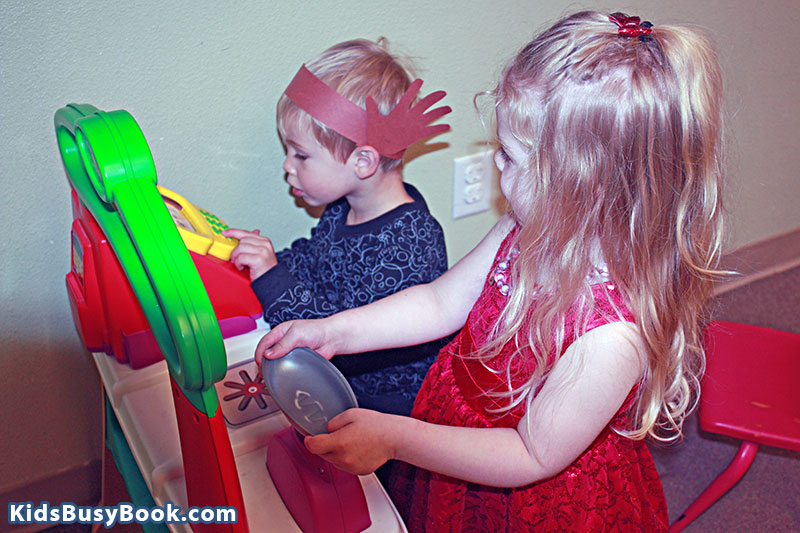
Theo Sharing a Preschool Grocery Counter with a Friend

Bombs, Guns and Bad Guys Allowed

I am becoming so alarmed by news stories of small children being suspended for pretending to have guns or grenades. These little people are having their academic records tainted, and their psyches damaged, by grownups who take a child’s gun play far too seriously. You cannot prevent a child from becoming violent by preventing him from pointing his finger at a friend and saying pew pew. And he will not become violent because he pretended to be a bad guy with a bomb. Overreacting to the imaginative play that makes some adults uncomfortable is far more likely to produce resentful children who, I don’t know, may become more violent as a result.

Kids Don’t Have to Say “Sorry”

Short and sweet: if a child doesn’t mean she’s sorry, she shouldn’t have to say it. The youngest children who are often compelled to say these words don’t really know what they mean. So what the child learns is that it’s okay to do certain behaviors, or be careless, because all you have to do afterwards is say you’re sorry. Instead, we ought to point out how her behavior hurt someone else, how that other child is crying for example. Let the first child get a sense of how her actions affect other. Then ask her if she can agree not to do it again. Chances are she will really try not to.


It’s OK Not to Share and Other Renegade Rules for Raising Competent and Compassionate Kids
by Heather Shumaker
Tarcher (August 2, 2012)
400 pages
ISBN-10: 1585429368

This article was originally published on 3/9/2013 at KidsBusyBook.com, and now lives here.

Categories: Behavior & Discipline, Development, Emotional Health & Safety, Physical Health & Safety 1 Comment / Share

« Memories of a Childhood Outdoors
When Siblings Fight… »

Comments

  1. Heather says

    October 18, 2015 at 3:01 pm

    I agree. I shudder whenever I hear someone say, “Sharing is caring.”
    Our kids love to play with sticks; their imaginations are vast; the sticks are used as canes, guns, swords, wands, etc. Fantasy play is good for them. Let kids play! It’s the adults that turn play into something it isn’t.

    Reply

Leave a Reply Cancel reply

Your email address will not be published. Required fields are marked *

Your journey for better parenting starts here! Sign up for our newsletter and get expert advice on effective parenting techniques delivered to your inbox.

Topics

  • babies
  • Behavior & Discipline
  • Big Kids (6-12)
  • Development
  • education
  • Emotional Health & Safety
  • Family & Siblings
  • Feeding & Nutrition
  • Hygiene & Potty
  • Physical Health & Safety
  • Play & Education
  • Pregnancy & Fertility
  • preschoolers (age 3- 5)
  • Sleep
  • Teens
  • Toddlers


Classes & Workshops

Classes & Workshops — Bringing parents together to have more confidence in parenting...even when it's hard. Book your seat now →

Personal Coaching

Set up a one-on-one session for your unique situation & start implementing strategies confidently and quickly. Request a free consultation →

Speaking Engagements

Ask Kelly to talk at your school, workplace, place of worship or other community event. Learn More →


Your journey for better parenting starts here! We will guide you & mentor you for maintaining better relationships with your kids. Sign up for our newsletter and get tips & expert advice on effective parenting techniques delivered to your inbox.

Daily Parenting Inspiration

“My child is not giving me a hard time… my child i “My child is not giving me a hard time…
my child is having a hard time.”

That one shift changes everything.

Less: “Why are they doing this?”
More: “What’s going on for them?”

Hard behavior is often just… hard feelings.

When we see the struggle,
we respond differently.

Less reacting.
More supporting. 💛 #respectfulparent #sandiegomoms #parenteffectivenesstraining #attachmentparenting #rie #PositiveParenting #parentingtips #DefianceOrMisunderstanding
“I didn’t say it was your fault… I said I blame yo “I didn’t say it was your fault…
I said I blame you.” 😅

When kids blame, it feels personal.

But it’s usually not about being right…
it’s about letting out big feelings.

Blame =
“I’m frustrated.”
“I’m overwhelmed.”

Before correcting, try connecting:

“You’re really upset.”
“That was hard.”

Less defending.
More understanding. 💛
“Children do well when they can.” So when they’re “Children do well when they can.”

So when they’re not…
It’s not about won’t.
It’s about can’t (yet).

Less: “Why are they acting like this?”
More: “What’s getting in their way?”

Skills take time.
Emotions get big.
Brains get overwhelmed.

And in those moments,
they don’t need perfection…

They need curiosity - not furiosity. 😋💛

Yup, I made up a word.

#respectfulparent #childrendowellwhentheycan #drrossgreen #parenteffectivenesstraining
End of school = chaos… Then suddenly… no structure End of school = chaos…
Then suddenly… no structure 😅

Or camp… to camp… to camp.

Summer is fun ☀️
But it can also mean:
more pushback
more “I’m bored”
more sibling stuff
more BIG feelings

And when routines change, behavior usually does too.

The good news?
You don’t need more control… you need better tools.

✨ listen without shutting them down
✨ set limits without the battles
✨ handle big emotions (theirs + yours)

Less surviving
More thriving

My summer Parent Effectiveness Training class is coming up 💛
Drop a ☀️ and I’ll send details!

 #respectfulparent #sandiegomoms #parentingtips #parentingmiddleschoolers #PositiveParenting #attachmentparenting #rie #parenteffectivenesstraining #RespectfulParenting
Oof. This is a hard one sometimes! Share your exam Oof. This is a hard one sometimes! Share your examples of a time this happened 🙏🏼🙈
I'm just reading the book "Untangled -Guiding Teen I'm just reading the book "Untangled -Guiding Teenage Girls Through The Seven Transitions into Adulthood" by @lisa.damour ,  and I love it. This one struck a chord with me so I thought I'd share. It's from the section "The Pull of Popular."

What does “popular” actually mean?

Because when you look a little closer, the kids who seem the most “popular” aren’t always the most liked. Sometimes, their influence comes from social power, not genuine connection. And that can come with a lot of pressure—on everyone.

This can be a powerful conversation to have with your child.

Not in a lecture-y way, but with curiosity:
“Do kids actually like being around her, or are they worried about being on her bad side?”
“What makes a friendship feel good to you?”

Helping kids think beyond popularity and toward the quality of their friendships gives them something much steadier to stand on.

Because in the long run, feeling safe, accepted, and able to be yourself matters a whole lot more than being “popular" and then you may just hit that sweet spot of being "popular" because you are well liked!

 #parentingtips #sandiegomoms #respectfulparent #raisingteenagegirls #parentingmiddleschoolgirls
We have dreams for our kids. The friends we hope We have dreams for our kids.

The friends we hope they choose.
The sports we hope they love.
The grades we hope they earn.
The path we quietly map out in our minds…

And then they grow.
And they choose.

Sometimes differently than we imagined.

And that’s where it gets uncomfortable.

Because the real question becomes:
Are we raising children who follow our path…
or children who can find their own?

Letting go doesn’t mean stepping back completely.
It means shifting roles.

From director ➡️ to guide
From fixing ➡️ to listening
From telling ➡️ to being available

It means offering wisdom when it’s invited,
and trusting them enough to figure some things out on their own.

That’s not easy.

But that’s where confidence is built.
That’s where ownership grows.
That’s where they become themselves.

Not a version of us.

If this hits home, this is exactly the kind of skill we work on in Parent Effectiveness Training—how to support your kids without shutting them down.
My next class starts in less than two weeks:
☀️ Tuesday Mornings
🗓️ April 7th – May 26th
⏰ 9:30 am – 12:30 pm (Pacific Time)
📚 Eight classes
And of course, I'm still working on this!

Reg info in first comments/bio 👇👇
My daughter was venting to me about a recent pract My daughter was venting to me about a recent practice…
and of course, I did what many of us do.

I offered a solution, "I mean, you don't really need to go next time; it's optional." 

Her response?

“Mom… I just need to complain, not fix it. I'm still going.”

…Heard. 😅

It was such a good reminder.

When kids come to us upset, our instinct is to help. To fix. To make it better. But sometimes all of our great ideas land like this:

🚪 door closes
😶 conversation over

Because what they actually needed wasn’t a solution.
It was space.

Space to vent.
Space to feel heard.
Space to figure it out themselves.

And when we jump in too quickly with advice, it can unintentionally send the message:
“You can’t handle this.”
or
“Your feelings need fixing.”

Even when that’s the last thing we mean.

Sometimes the most helpful thing we can say is:
“That sounds really frustrating.”
“Ugh, that’s tough.”
“I’m here.”

That’s it.

No fixing. No coaching. No life lesson.

Just connection. 💛

(Still practicing this over here, by the way 🙋‍♀️)

If this hits home, this is exactly the kind of skill we work on in Parent Effectiveness Training—how to support your kids without shutting them down.

My next class starts in less than two weeks:

☀️ Tuesday Mornings
🗓️ April 7th – May 26th
⏰ 9:30 am – 12:30 pm (Pacific Time)
📚 Eight classes
And of course, I did what many of us do.
Reg info in first comment 👇👇

Come learn how to listen in a way that actually keeps your kids talking.

 #PositiveParenting #parentingclasses #ParentEffectivenessTraining #respectfulparent #rie #attachmentparenting #sandiegomoms #parentingtips
Follow on Instagram


  • Privacy Policy
  • Free Consult

© 2026 Respectful Parent · All Rights Reserved.

  • Facebook
  • Instagram